10 ManageEngine alternatives for modern IT teams
Published
ManageEngine offers more than 60 products covering areas like IT service management (ITSM), endpoint management, and identity and access management (IAM).
That breadth makes evaluating ManageEngine alternatives difficult. The first question to answer isn’t which competitor is most comparable; it’s which part of ManageEngine you’re trying to replace.
Discover how 10 alternatives stack up across different services, like ITSM and remote monitoring and management (RMM).
Why IT teams outgrow ManageEngine
ManageEngine is a widely used platform, and many organizations run it successfully for years. But changing requirements often encourage teams to explore other solutions.
In some cases, the service desk requires too much manual work. In others, it’s patch management, reporting, or licensing costs. If you're evaluating a ManageEngine alternative, there's a good chance one of the following challenges is driving the search.
What started off simple takes more time and effort to maintain
ManageEngine offers a lot of flexibility, which can be valuable as requirements become more complex. But for some teams, that comes with additional administrative overhead. Tasks that were straightforward during initial rollout can become harder to manage as the environment grows and new requirements stack up.
Licensing costs have grown alongside the support team
ManageEngine can be cost-effective early on. But that may change once the IT team grows. Many products use technician-based licensing, which means adding support capacity often adds licensing costs. Over time, organizations may start looking for pricing models that scale differently.
Patching isn’t always as hands-off as expected
Patch management should be as simple as deploying updates and moving on. But in practice, failed deployments, troubleshooting, and exception handling often require hands-on attention from IT teams. For organizations managing hundreds or thousands of devices, those manual touchpoints add up.
Teams want fewer tickets, not just faster ticket routing
Password resets, access requests, and onboarding tasks are some of the most common tickets IT teams deal with. These requests aren’t particularly complicated. They're just repetitive. That’s why many organizations are investing in AI automation to handle routine tasks. This frees IT teams to focus on security initiatives that move the business forward.
Reporting becomes more important as organizations grow
As companies scale, reporting requirements grow alongside them. Whether it’s an audit or a compliance review, IT teams need reliable data and clear audit trails. And when generating that information requires too much manual effort, a few necessary workflows may take hours to complete.
10 ManageEngine competitors worth exploring
Before we get into the list, let’s take a look at a quick overview of the platforms:
| Tool | Coverage area | Automation depth | Best fit |
|---|---|---|---|
| Serval | ITSM, workflow automation, access management | High | Organizations looking to automate common IT requests without compromising control |
| Freshservice | ITSM, IT asset management | Medium | Teams who want routine task automation |
| SysAid | ITSM, IT asset management | Medium | Teams working on-premise who want to add an AI layer |
| Jira Service Management | ITSM, service management | Medium | Organizations already using Atlassian products |
| SolarWinds Service Desk | ITSM, asset management, CMDB | Medium | Teams who want a service desk with asset management capabilities |
| Action1 | Patch management, vulnerability remediation | High | Organizations looking for enterprise-grade security without complex infrastructure |
| NinjaOne | Endpoint management, patch management, remote support | High | IT teams looking to combine endpoint management and IT operations |
| Ivanti Neurons | Endpoint management, ITSM, security | High | Larger organizations managing endpoint, service, and security operations |
| Atera | RMM, help desk, patch management | Medium | IT departments and MSPs looking for RMM, ticketing, and device management |
| Syncro | RMM, PSA, endpoint management | Medium | Growing MSPs and IT teams who want RMM, PSA, and endpoint management |
The best alternative to ManageEngine depends on your goals. To make comparisons easier, we grouped the following tools by the primary ManageEngine capability they often replace.
ITSM and service desk alternatives
Here are the best platforms that handle IT service delivery,
- 1.
Serval
If your main objective is finding a ManageEngine ServiceDesk competitor, Serval is the closest fit on this list.
Built as an AI-native ITSM platform, Serval’s automated workflows resolve requests end to end instead of routing them through queues. Employees can make requests, like password resets and software access, or ask IT questions directly through Slack or Microsoft Teams.
Serval’s AI-powered help desk only executes workflows built by your admins. These actions are deterministic, giving you secure peace of mind and a full audit trail.
- Best for: Organizations looking to modernize their service desk and automatically resolve IT requests
- 1.
Freshservice
Freshservice is Freshworks' ITSM platform featuring service management, asset management, workflow automation, and AI capabilities through Freddy AI. The Freddy AI Agent automates routine tasks using a usage-based pricing model. It's a strong fit for growing teams, but companies may hit a ceiling due to session caps.
- Best for: Teams that want ITSM, asset management, and workflow automation in one platform
- 1.
SysAid
SysAid combines components like ITSM, workflow automation, and AI capabilities. It’s an AI-first solution designed to help teams manage requests, changes, and assets from one system. SysAid is available for cloud and on-premise deployment.
- Best for: On-premise teams looking to add an AI layer
- 1.
Jira Service Management
Jira Service Management is Atlassian's service management platform for IT, development, and operations teams. It manages a range of support tasks, like accessing knowledge bases to answer employee questions.
- Best for: Teams already using Jira and other Atlassian products.
- 1.
SolarWinds Service Desk
SolarWinds Service Desk is a cloud-based ITSM platform that includes incident management, asset management, and AI-powered service desk capabilities. It features AI workflows that route requests, monitor ticket sentiment, and recommend responses.
- Best for: Teams looking for a traditional service desk platform with a built-in hardware and software inventory
Endpoint management and patch management alternatives
Here are a few platforms focused on security and updates.
- 1.
Action1
Action1 focuses on patch management and vulnerability remediation. It helps IT and security teams identify missing updates, deploy patches, and track compliance across managed endpoints.
- Best for: Organizations that want strong security without on-premise infrastructure
- 1.
NinjaOne
NinjaOne combines capabilities like endpoint management, patch management, and remote access in a single platform. It enables centralized RMM, letting teams track and support devices in real time.
- Best for: IT teams looking to consolidate device management and IT operations workflows.
- 1.
Ivanti Neurons
Ivanti Neurons is a platform featuring endpoint management, ITSM, and security capabilities. It uses governed AI, led by organizational data, to resolve issues automatically.
- Best for: Larger organizations looking for a platform that spans endpoint, service, and security management
RMM and MSP-focused alternatives
Here are some tools that excel at device management.
- 1.
Atera
Atera focuses on RMM, patch management, and AI capabilities. It uses Robin, an AI agent that resolves device and cloud issues automatically, routing requests when needed.
- Best for: IT departments and MSPs that want RMM, ticketing, and endpoint management
- 1.
Syncro
Syncro combines RMM and professional services automation (PSA) capabilities with endpoint management, ticketing,and Microsoft 365 administration tools. It has technician-based pricing and built-in ticketing, making it a good choice for lean teams.
- Best for: MSPs and IT teams that want RMM, PSA, and endpoint management in one platform
How Serval helps IT teams automate repetitive requests
Most IT teams don't need another way to manage tickets. They need fewer tickets to manage.
With Serval, employees can resolve requests in moments, taking one more thing off IT’s to-do list. Our platform uses deterministic workflows built by your admins to provision and deprovision access, reset credentials, and handle onboarding tasks. When these workflows trigger, Serval can connect to your systems via direct integrations with Okta and Microsoft Entra ID.
Auditability is baked in; Serval logs every run and separates workflow creation from execution. Your team designs each action with the Workflow Builder. Unlike ManageEngine, Serval compiles your plain-language description into deterministic TypeScript you can read and edit. The Help Desk Agent can only call published workflows. It can’t create or modify them, and it runs in a separate environment from the authoring agent.
Then, the Help Desk Agent calls these pre-determined actions whenever an employee needs help. The result is a fast, security-first service desk that scales without creating more work for the people running it.
That’s what made Serval a fit for Together AI. Our platform automates 95% of Together AI’s just-in-time access requests and assists with the remaining 5%.
Serval tracks the full conversation, including duration and business justification, providing a record for approval, review, and audit.
Book a demo today to see Serval in action.
You may also be interested in

Sam Stewart joins Serval as Head of Security
Sam Stewart will lead security at Serval as its AI agents take on more of the enterprise's most sensitive work.
Company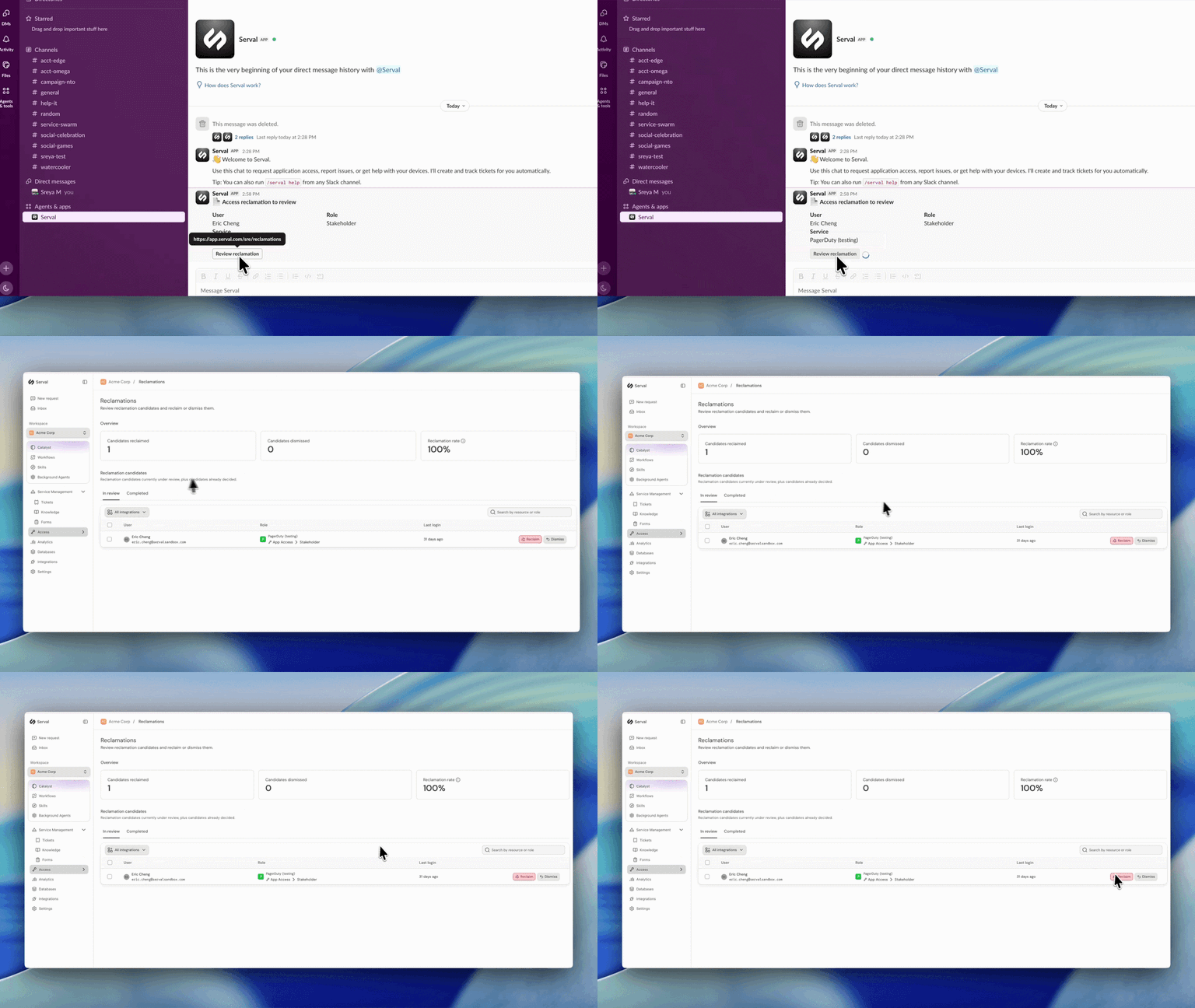
Introducing automated license reclamation
Serval reclaims seats as they go unused, on a policy you set once.
Product
Announcing general availability of Catalyst
Today, we're excited to announce that Catalyst is generally available and will be enabled by default for all organizations.
Product