What does shadow AI mean for security teams?
Published
Most employees who use unapproved AI tools aren’t trying to sidestep security. They just want to finish a task quickly, and a public chatbot or AI coding assistant can solve a problem in seconds instead of days.
That speed comes at a cost: visibility. When employees use generative AI apps, browser extensions, or LLM APIs without going through IT service management (ITSM) review, sensitive data can move through tools the organization has never reviewed or approved.
Keep reading to learn the meaning of shadow AI and how to manage it without slowing employees down.
How shadow AI differs from shadow IT
Shadow IT is employees using technology without IT's knowledge or approval. Shadow AI is that same pattern applied to GenAI and other artificial intelligence tools.
AI raises the stakes because employees may share company information directly with these tools, including customer records, proprietary code, and internal documents. This leaves security teams with less visibility into where sensitive information goes or how it's handled.
Why shadow AI happens at enterprise organizations
Shadow AI can take hold even in organizations with established IT governance. Policies may be in place, but they don’t always match the speed at which employees encounter and adopt new AI tools. A few factors make this especially common:
- Slow approval processes: When getting an AI tool approved takes days or weeks, employees have an incentive to find an alternative they can use immediately.
- AI features appear in existing software: SaaS vendors may add AI capabilities to products employees already use. Those features often go into play before security has had a chance to review them.
- Policies don’t always keep pace: New AI tools and use cases pop up all the time. Without clear AI governance to tell them what’s allowed, employees are left to make their own judgment calls.
Common examples of shadow AI in enterprise IT
Shadow AI often starts with an ordinary task:
- A support employee might paste customer data into a public LLM to draft a response.
- A developer might use an unapproved AI coding assistant to troubleshoot proprietary code.
- A manager could upload confidential strategy documents to a GenAI tool to summarize it before a meeting.
The platforms and information may change, but the pattern is similar. Employees use AI tools to get work done faster without considering whether the tool has been reviewed. For security teams, those everyday decisions make unauthorized AI use much harder to see and govern.
Risks of shadow AI for enterprise organizations
At the enterprise level, the biggest AI risks come from losing visibility into how employees use company data and which tools touch it. That creates several problems for security and compliance teams:
- Sensitive data can leave approved environments: Employees may enter customer information, source code, or internal documents into unauthorized AI tools. Once that happens, the organization may have limited visibility into how the provider handles or retains the data.
- Compliance gets harder to enforce: Unauthorized AI use may bypass controls designed to govern how sensitive or regulated information is handled. Security teams then have to account for activity that happened outside their established processes.
- Audit trails become incomplete: If AI use happens outside approved systems, there may be no reliable record of who used a tool or what information they shared. That makes it harder to demonstrate security and compliance controls during an audit.
- Unvetted outputs can influence business decisions: Employees may act on AI-generated analysis without knowing how reliable it is. Without a way to vet those outputs, organizations risk treating unreliable analysis as trustworthy.
How to manage and reduce shadow AI
Reducing shadow AI requires giving employees a practical way to use AI within the organization’s rules. Policies matter, but so do the processes employees have to follow when they want access. Here’s how to do it right.
Establish clear AI usage policies before banning anything
Employees need to know which AI tools are approved and what types of company data can be shared. Clear AI governance gives people boundaries they can actually follow instead of leaving them to make those calls on their own.
Create a fast-track approval process for AI tool requests
Approval processes need to match the speed of the work itself. When employees can get an answer in minutes instead of waiting through a lengthy review, they have far less reason to bypass the process altogether.
Automated workflow approvals can remove some of that friction by sending requests directly to the right approver based on the organization’s access policy. For sensitive access, just-in-time (JIT) privileged access management can limit how long elevated permissions stay available.
Monitor existing SaaS tools for quietly added AI features
An approved application can change after its initial security review. Teams should track AI features added to existing SaaS products and determine whether the new functionality changes how company data is processed.
Train employees on what’s allowed, not what’s forbidden
Policies are easier to follow when employees understand what they can do. Training should give people practical guidance for common situations. This includes which information is safe to enter into approved AI tools and when a new use case needs security review.
Build audit trails for AI tool access approvals
Approved access should leave a record. Security teams need visibility into who requested access and who approved it so they can answer those questions later without piecing together information from multiple systems.
Regular user access reviews help teams confirm that access still matches current roles and policies. Combined with clear approval records, they give security teams a more reliable picture of who has access to sanctioned AI tools.
How Serval makes AI tool access fast and auditable
If employees can get an answer on an AI tool request quickly, there’s less reason to look for workarounds. Serval makes that possible by bringing access provisioning into the channels employees already use. An employee can request access through Slack or Teams, and Serval routes the request to the right approver based on the company’s access policy. Once approved, Serval provisions the access by calling your IdP (Okta or Entra) to add the user to the right group. For AI tools that don't support SCIM, a Serval workflow calls the vendor's own API directly. Every step lands in the audit log.
With security automation, faster approvals don’t have to mean less oversight. When an auditor asks who received access and who signed off, security doesn’t have to reconstruct the answer from tickets and messages.
Serval helps enterprise security teams approve and provision AI tool access in minutes instead of days, so employees have a sanctioned path that's faster than the workaround. And every approval leaves an audit record.
Book a demo today to see how Serval makes the approved path the easier path.
FAQ
Why does generative AI create new risks for governance?
Generative AI makes shadow usage difficult to govern because employees may share company information directly with tools security hasn’t reviewed. The resulting AI risks depend on what data employees share and how each tool handles it. Strong AI governance gives teams a consistent process for reviewing those tools before sensitive information reaches them.
Why is shadow IT risky?
Shadow IT puts company systems and data outside the usual security review. IT may not know which tools employees are using or what information they’re sharing, making existing access controls and policies harder to enforce.
What are the risks of shadow data?
Shadow data is information stored or handled outside governed systems. Without visibility, security teams may have a harder time controlling access or determining whether sensitive information is being handled according to company policy.
What kinds of confidential information might employees put into unapproved AI tools?
Sensitive business data like customer information, proprietary code, and internal strategy documents may end up in unapproved AI tools during routine work. That’s why clear policies around what employees can share with AI tools matter even when the task itself seems harmless.
How does AI governance help reduce shadow AI?
AI governance gives employees clear rules for using GenAI and other AI models at work. Strong security practices help teams decide which tools are appropriate for company data and when additional review is needed. When those expectations are clear, employees have fewer reasons to make security decisions on their own.
You may also be interested in

Sam Stewart joins Serval as Head of Security
Sam Stewart will lead security at Serval as its AI agents take on more of the enterprise's most sensitive work.
Company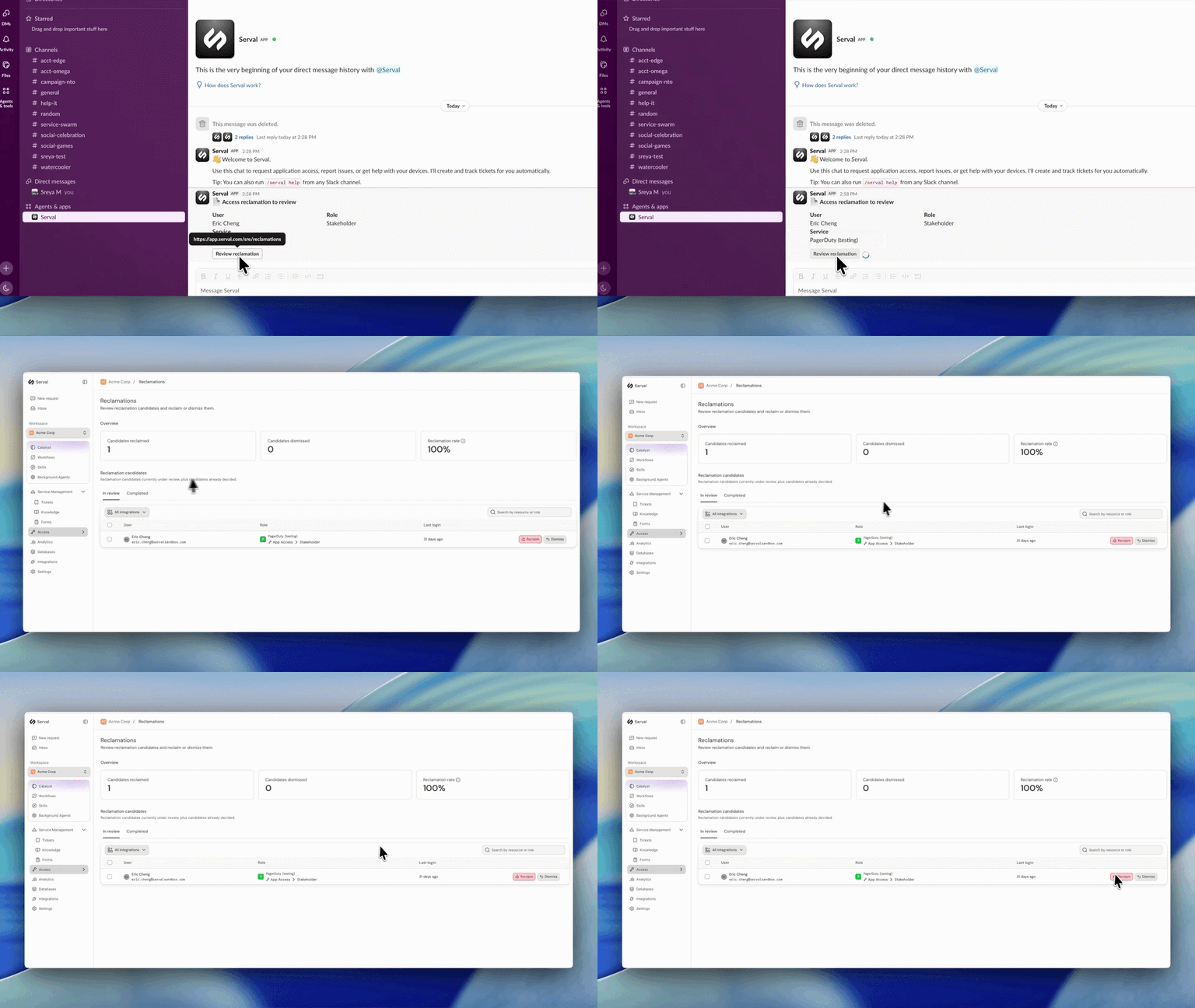
Introducing automated license reclamation
Serval reclaims seats as they go unused, on a policy you set once.
Product
Announcing general availability of Catalyst
Today, we're excited to announce that Catalyst is generally available and will be enabled by default for all organizations.
Product