9 best ITSM platforms for modern IT teams
Published
Traditional IT service management (ITSM) platforms track and route problems. This manual process keeps technicians trapped in a reactive loop, wasting hours on identical password resets and repetitive provisioning requests.
Modern service management takes a proactive approach. Teams use AI-native tools to resolve issues end to end rather than passing tickets down a human queue. This automation reduces routine work without compromising compliance and security.
Below is a capability-by-capability comparison of nine ITSM platforms, plus the criteria that separate them.
Core features in an IT service management platform
Basic tracking systems are quickly losing relevance to modern teams. If you’re looking for complete automation, consider these features in an ITSM solution:
- Workflow automation: Replaces repetitive manual ticket routing and access provisioning chores with automated background processes
- Incident management: Provides a structured environment for logging and prioritizing unexpected outages to minimize system downtime
- Problem management: Identifies root causes behind recurring incidents to help engineering teams deploy permanent infrastructure fixes
- Change management: Tracks technical dependencies and formalizes rollback plans to minimize risk during infrastructure updates
- Asset management: Links physical devices and SaaS seats to user profiles, eliminating manual spreadsheet tracking
- Self-service portal: Allows employees to surface documentation instantly and resolve basic questions without human intervention
Well-designed systems don’t just complete tasks. They examine groups of tickets to discover new automation opportunities. This continuously improves ITSM processes and shapes workflows around your organization’s needs.
The 9 best IT service management platforms
ITSM tools take different approaches to tracking and automating requests. Finding the right fit means looking closely at how each tool handles day-to-day tickets. Here’s how the top platforms compare.
- 1.
Serval
Serval is an AI-native ITSM platform that resolves routine, high-volume tickets end-to-end, cutting down on manual triage and routing. Instead of categorizing an issue or routing it to a technician, AI Help Desk agents actively clear support queues.
- Best for: Enterprise companies looking to automate high-volume support queues
- Primary strength: Features plain-English workflow generation that runs on deterministic TypeScript code
- Automation performance: Resolves routine incidents end to end, automating at least 50% of help desk tickets
- 1.
ServiceNow
ServiceNow ITSM is enterprise software that connects core support workflows and automates requests.
- Best for: Large enterprises that need customized workflows and extensive multi-department corporate governance
- Primary strength: Uses autonomous AI agents to handle routine requests
- Automation performance: Resolves routine incidents independently
Note: Serval offers a native ServiceNow integration, allowing enterprise teams to transition gradually without a sitewide rip-and-replace project.
- 1.
Freshservice
Freshservice is ITSM service desk software tailored to organizations seeking quick internal deployment times.
- Best for: Businesses that prioritize quick setup and a low initial learning curve
- Primary strength: Simple interface and ticket visibility
- Automation performance: Deflects and resolves common requests via Freddy AI Agent, escalating complex issues to a human queue
- 1.
Jira Service Management
The Jira ITSM connects support operations to software development teams within the Atlassian ecosystem.
- Best for: IT service desk teams who constantly collaborate with product engineering
- Primary strength: Uses Atlassian Intelligence and Rovo agents to deflect and resolve routine requests, alongside AI-suggested responses for agents
- Automation performance: Resolves some routine requests via Rovo agents, routing complex issues to a human queue
- 1.
SysAid
SysAid combines traditional ticket management with generative AI capabilities. The platform focuses primarily on organizing, summarizing, and tracking support tickets.
- Best for: Enterprise IT teams
- Primary strength: Features simple visibility into IT assets, including hardware, software, and cloud tools
- Automation performance: Completes requests fully
- 1.
BMC Helix
BMC Helix is an ITSM that focuses on predictive operations. It uses machine learning to monitor multi-cloud infrastructure environments and identify vulnerabilities.
- Best for: Large organizations with hybrid infrastructure that require combined service and operations tracking
- Primary strength: AI problem tracking insights that identify issues early
- Automation performance: Uses AI for root-cause detection and automated remediation recommendations, layered across its ITSM and AIOps stack
- 1.
Zendesk
Zendesk approaches ITSM from a customer service perspective, prioritizing the user experience. The software consolidates incoming requests from email, chat, and messaging into a unified agent inbox.
- Best for: Teams who want a straightforward, communication-focused help desk
- Primary strength: Helps teams manage ticket, incident, and knowledge tasks in a central hub
- Automation performance: Resolves requests independently but less flexible to customize
- 1.
ManageEngine ServiceDesk Plus
ManageEngine ServiceDesk Plus provides an ITSM solution available for cloud and on-premise deployments. The software packages asset tracking, project management, and contract compliance into a single administrative portal.
- Best for: Lean IT departments that need full ITIL alignment
- Primary strength: Combines IT service and asset management
- Automation performance: Automates certain tasks
- 1.
SolarWinds Service Desk
SolarWinds Service Desk delivers an ITIL-aligned platform focused on centralizing requests and tracking asset management data. The software integrates natively with broader SolarWinds monitoring tools, converting alerts into incidents with field mapping for context.
- Best for: Internal IT groups who rely on the broader SolarWinds ecosystem for network and infrastructure monitoring
- Primary strength: Integration with SolarWinds monitoring tools and the ability to import metrics
- Automation performance: AI-assisted triage
How to choose the right ITSM software for your organization
Choosing an IT service management platform shouldn't feel like a generic checklist exercise. Use this practical plan to find a tool that actually fits your team's daily reality.
Audit team pain points
Spend a week tracking ticket volume, mapping manual workflows, and identifying access provisioning gaps. Documenting these specific operational hurdles reveals exactly which technical capabilities matter most to your day-to-day survival.
Assess your actual technical capacity
Lean IT organizations should prioritize platforms engineered for fast setup, intuitive management, and low maintenance overhead. Choosing a complex enterprise platform when you lack a dedicated deployment team is likely to leave you stuck with an expensive, underused system.
Map out your precise integration requirements
Before reaching out to a software vendor, make a list of your must-have integrations. This might include identity providers, communication hubs, and device managers. An ITSM platform that doesn’t connect natively with your stack creates extra work instead of reducing overhead.
Decide the automation depth you need
If metrics show that most incoming tickets consist of standard requests, prioritize platforms that resolve tasks end to end. Selecting software that deflects repetitive issues to a human queue keeps engineers in a reactive triage cycle. Automation lifts a significant strain off your team and lets them focus energy on critical issues, like managing data backups and software patches.
Run a live pilot program before committing
Avoid signing a long-term commercial contract based on a polished vendor demo. Spend two to four weeks testing a platform with real incoming tickets and your actual software stack. This gives you solid, reliable data on how the tool will perform in your environment.
Why Serval is built for modern IT service management
Serval delivers an AI-native platform that covers real IT needs, from built-in access management to natural language workflow automation. Admins describe a workflow in plain language, Serval compiles it into deterministic code, and the Help Desk Agent calls only those pre-approved actions. And every run is logged for audit.
This platform helped high-growth innovators like Perplexity, Mercor, and Together AI automate over 50% of their incoming tickets end to end. Reduce administrative overhead and build smarter workflows under a predictable, flat fee.
Book a live demo with Serval, and see how AI helps teams automate, iterate, and grow.
You may also be interested in

Sam Stewart joins Serval as Head of Security
Sam Stewart will lead security at Serval as its AI agents take on more of the enterprise's most sensitive work.
Company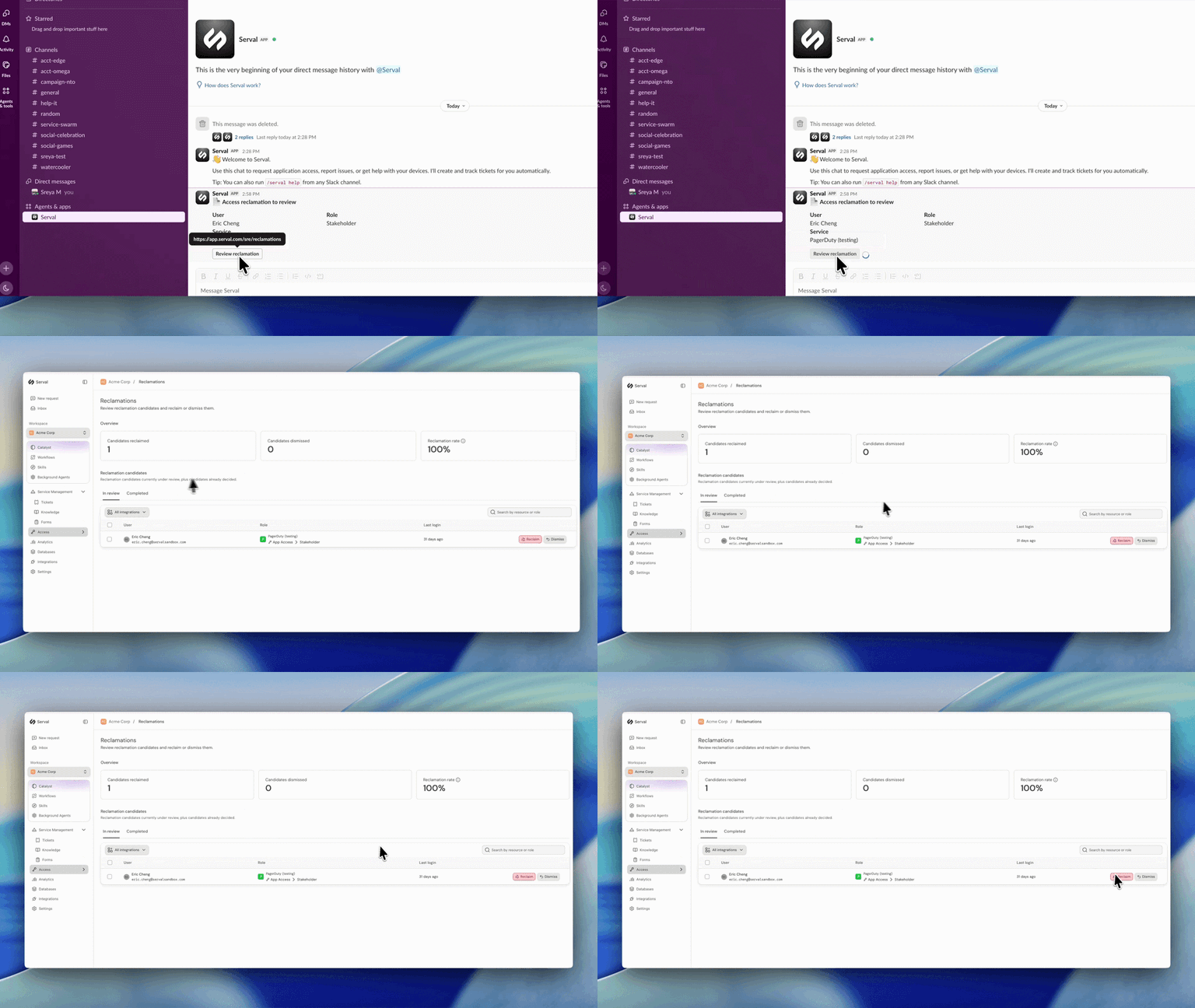
Introducing automated license reclamation
Serval reclaims seats as they go unused, on a policy you set once.
Product
Announcing general availability of Catalyst
Today, we're excited to announce that Catalyst is generally available and will be enabled by default for all organizations.
Product