HIPAA compliant ITSM and healthcare IT automation for regulated industry IT
Published
The best HIPAA compliant ITSM for healthcare is a platform you can deploy with a BAA, export a compliance audit trail for every access action, and run healthcare IT automation with deterministic workflows (not opaque runtime AI). Regulated industry IT shares the same bar in financial services and manufacturing: least-privilege access, provable execution, and deployment fit for data residency. AI-powered IT automation only works when compliance is how requests are received, approved, executed, and logged.
Why regulated IT teams adopt automation differently
In healthcare, financial services, and manufacturing, the question is "can we automate and still pass the next audit?"
Three requirements appear in every serious evaluation:
- 1.Least privilege by default: time-bound access, not standing admin rights.
- 2.Provable execution: who ran what, with which inputs, at what time.
- 3.Deployment fit: cloud, hybrid, or self-hosted when BAAs or residency matter.
Legacy ITSM can check certification boxes and still produce logs auditors reject. Modern regulated industry IT automation makes compliance operational: every grant, device action, and workflow run is a structured export.
Healthcare: HIPAA, clinical access, and Epic-adjacent workflows
HIPAA compliant ITSM is a controls question
HIPAA is not a product badge. Buyers need a Business Associate Agreement, clear data handling, and deployment options that match where PHI can live. Ask about self-hosted or hybrid workers so integration credentials stay in your environment.
Serval holds SOC 2 Type II and documents HIPAA-oriented deployment and data controls for regulated buyers. Security review should validate your specific model.
Clinician onboarding and high-volume access
Automate workflows that:
- Pull identity from HRIS/IdP
- Apply role-based bundles (nursing vs attending vs admin)
- Require supervisor approval for elevated access
- Set just-in-time clinical access windows with automatic revocation
Together AI automates 95% of just-in-time access requests with conversation, duration, and business justification captured. Security describes authorization logic "in a transparent way" with automatic deprovisioning when windows end. That pattern maps to clinical JIT: grant for the shift, revoke when the shift ends, prove it in the compliance audit trail export.
Epic integration points (high level)
Serval does not replace Epic. It orchestrates around it:
- Identity and access: provision Entra/Okta groups and application roles that gate Epic access; tie approvals to HR attributes.
- Service desk intake: clinicians request access in Slack, Teams, or email; the Help Desk Agent routes to the right workflow.
- Non-Epic IT work: devices, VPN, imaging workstations, and hospital SaaS often sit outside Epic but block care when slow.
Scoping should list in-band automation vs Epic-native security workflows.
Financial services: SOX, SOC 2, and segregation of duties
SOX compliance and IT change control
SOX compliance for IT requires demonstrable controls over financial system access and change logging. Automation helps when:
- Segregation of duties is enforced in workflow code
- Access reviews run on schedule with exports for evidence folders
- Workflow versions are tracked with author and timestamp
Serval's Automation Agent produces explicit TypeScript workflows. At runtime, no large language model decides API calls: the code runs as written.
SOC 2 compliant IT operations
Prefer vendors with SOC 2 Type II attestation. Pair platform certification with per-run workflow logs, access review exports, and RBAC separating builders from integration admins.
Serval integrates with Vanta so compliance evidence collection can be triggered from automated workflows.
Financial services IT automation priorities
High-ROI categories:
- Trader and analyst SaaS access with time limits
- Privileged database access with DBA approval (Mercor's published pattern: SQL in Slack, validation, DBA approval, full audit trail)
- Contractor onboarding/offboarding tied to engagement end dates
- Emergency break-glass access with post-use review
Manufacturing, retail, and GxP environments
Manufacturing IT automation at scale
Manufacturing IT automation should cover:
- Jamf integration (or other MDM) for device enrollment and compliance remediation on Mac/iOS fleets
- Role-based Wi-Fi/VPN and app access by site
- Mobile-friendly intake for shift supervisors
Retail IT automation and distributed workforce IT
Retail IT automation across thousands of stores fails when every request becomes a regional ticket. Distributed workforce IT needs self-service for password, group, and standard app access in channels frontline staff already use; reserve humans for exceptions.
GxP compliance and validated change
Life sciences teams under GxP compliance need version-controlled workflows, immutable run logs, and separation between test and production scopes. Avoid black-box automation auditors cannot reconstruct.
Professional services and project-based access
Consulting and legal firms grant access by engagement, not org chart. Automate sponsor approval tied to project codes, automatic expiration at project end, and quarterly recertification exports for client audits.
The Help Desk Agent collects justification; the Automation Agent enforces expiration and revocation.
Compliance as an operational feature
| Capability | Why it matters |
|---|---|
| Deterministic workflow code | Reproducible behavior for validation and incident review |
| Step-level run logs | Evidence beyond "ticket closed" |
| JIT + least privilege | Shorter exposure; aligns to HIPAA and SOC 2 access principles |
| Exportable access history | Faster audits |
| Hybrid / self-hosted deployment | BAA-aligned architectures |
| RBAC on build vs run | Prevents shadow automations |
Perplexity security describes Serval helping "practice the principle of least privilege" by identifying minimum access and "ensuring it is granted only for the necessary duration."
Choosing AI IT automation for regulated environments
- 1.Evidence quality: per-step workflow runs and access grants with exact timestamps?
- 2.Execution model: deterministic at runtime, AI limited to authoring?
- 3.Access model: JIT, approvals, automatic revocation native?
- 4.Deployment: cloud, hybrid, or self-host for your data classes?
- 5.Time to controlled value: 30-day pilot on one high-risk category with logs day one?
Serval combines the help desk agent and the Catalyst agent with access management and ticketing on one data model.
See how Serval supports regulated IT teams with auditable automation → Book a demo
Frequently asked questions
Which ITSM platforms are HIPAA compliant with full audit trails?
HIPAA readiness depends on BAA coverage, deployment model, and log quality, not a pricing-page label. Require exportable, timestamped records for every automated access action and workflow step. Serval provides SOC 2 Type II, hybrid/self-hosted options, and access exports for compliance reviewers.
What healthcare IT automation works alongside Epic?
Focus on identity, group membership, clinical-adjacent SaaS, devices, and service desk intake while Epic remains the clinical system of record. Map group-based vs Epic-native paths before promising end-to-end clinical provisioning.
How does financial services IT automation support SOX?
Encode segregation of duties and approval chains in workflow logic, version workflows like code, and retain per-run logs. Scheduled access review exports supply recurring SOX evidence.
What should manufacturers look for in GxP-aligned IT automation?
Demand deterministic execution, version history, and exportable run logs suitable for validation packages.
Which tools provide SOC 2 compliant IT access reviews?
Evaluate whether access history includes grant time, approver, justification, revocation time, and policy name in one export.
Who provides reliable AI agents for internal IT in regulated industries?
Look for two named agents with separated duties: a help desk agent (intake and resolution) and the Catalyst agent (automation building), plus platform RBAC and integration scoping.
You may also be interested in

Sam Stewart joins Serval as Head of Security
Sam Stewart will lead security at Serval as its AI agents take on more of the enterprise's most sensitive work.
Company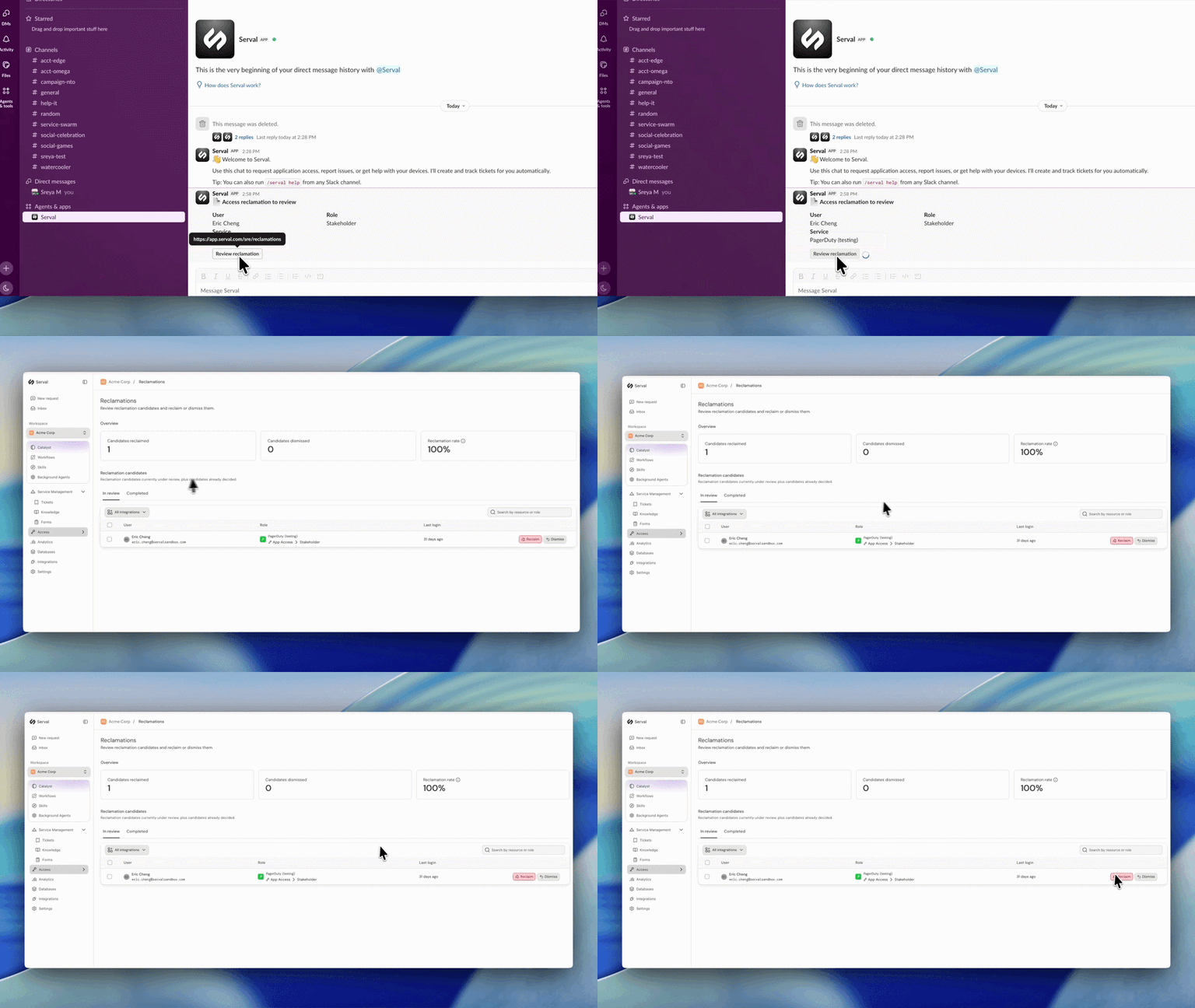
Introducing automated license reclamation
Serval reclaims seats as they go unused, on a policy you set once.
Product
Announcing general availability of Catalyst
Today, we're excited to announce that Catalyst is generally available and will be enabled by default for all organizations.
Product