AI-native ITSM vs. AI bolted on: what the difference means in practice
Published
AI-native ITSM platforms were built so automated ticket resolution in connected systems is the default path. AI bolted on to legacy ticketing adds copilots, routing, and suggested replies while agents still execute changes in Okta, the HRIS, and SaaS admin consoles. If you are evaluating modern ITSM in ITSM 2026 cycles, start with that architectural split, not feature checklists.
Every vendor ships an AI story this year. The labels sound identical: copilots, agents, deflection, orchestration. The practical difference is whether the system completes work or hands a cleaner ticket to a human.
The practical difference: resolution vs. routing
Routing means the platform classifies a request, assigns priority, suggests a knowledge article, or fills fields on a ticket. The employee may get a faster answer for FAQs. When the request requires action (grant access, reset MFA, onboard a user, update a group), IT still logs into Okta, the HRIS, or the SaaS admin console.
Resolution means the platform runs an approved workflow: checks policy, collects approval if needed, executes in the target system, confirms to the employee, and closes the audit record. IT is notified for exceptions, not for every routine grant.
| Outcome | AI bolted on ITSM | AI-native ITSM |
|---|---|---|
| Password/MFA issue | Article + ticket to agent | Automated reset via IdP workflow |
| Software access | Ticket routed to owner | JIT provision + time-bound revoke |
| Onboarding | Checklist for agent | Multi-system workflow from HR trigger |
| Metric emphasized | Agent handle time, CSAT | Automation rate (zero IT touch) |
Deflection is not automation. Deflection measures interactions that never became tickets or stopped at self-service content. Automation rate measures requests completed without IT involvement. Serval reports automation rate because that is what changes headcount math. A 70% deflection rate with 1,000 monthly requests still leaves 300 action tickets for IT. A 70% automation rate leaves 300 exceptions.
What AI-native means in product architecture
AI-native ITSM encodes three layers that share one data model:
1. Help Desk Agent. Conversational intake in Slack, Microsoft Teams, email, phone, or portal. The agent interprets intent, asks clarifying questions, and triggers workflows or escalates with full context.
2. Automation Agent. Plain-language descriptions become deterministic TypeScript workflows. IT reviews code before publish. The same code runs on every match. Runtime does not improvise new logic per ticket.
3. Insights Agent. Analyzes ticket history and help desk patterns to surface automation opportunities, suggest new workflows from what teams still resolve manually, and power analytics dashboards. This closes the loop: today's manual category becomes next week's published workflow.
AI-bolted ITSM typically adds a copilot to agent UI and a virtual agent on the portal. The ticket object remains central. AI speeds humans; it does not replace the execution step.
Mercor's Head of IT, Dana Stocking, described the outcome on Serval: "Zero touch tickets. Having an end user submit a ticket then have Serval use its guidance and workflows to automatically assist that person on complex tasks has allowed me to keep my team smaller and mightier." Mercor automates 60%+ of tickets while running workflows across seven teams without a top-down mandate.
Agentic ITSM: execution, not conversation alone
"Agentic" has become marketing noise. In evaluations, use a single test: does the agent change state in a system of record without a human click?
Agentic ITSM characteristics:
- Tool use with policy guardrails: call Okta, Jamf, Workday, ServiceNow APIs through scoped credentials, not open-ended browsing.
- Deterministic execution: published workflow code, not one-off LLM plans at runtime.
- Human-in-the-loop where required: approvals for sensitive roles, escalation with transcript attached.
- Air gap between conversation and build: employees cannot modify workflow code through chat.
AI-bolted platforms may call a connector "agentic" when it only posts a comment back to Slack. Press for a live run: show the Okta group membership before and after the interaction.
Perplexity completes over 50% of incoming requests automatically after moving from a traditional ITSM, saving each admin 1–2 hours per day while scaling headcount 3× with the same IT team. Vernon Man, Head of IT: "Once we switched over to Serval, we were able to complete over 50% of our incoming requests automatically."
What AI bolted on looks like in real deployments
Teams on Freshservice, Jira Service Management, or other legacy ITSM platforms with AI assist add-ons often describe the same pattern: approvals get faster, summaries are helpful, but provisioning still requires an agent to log into each application. That is not a failure of IT. It is the architecture ceiling.
Symptoms you are on a bolt-on model:
- Automation projects require developers or professional services for each new integration.
- "AI" features live in a separate SKU or admin console from ticketing.
- Success stories cite agent productivity, not percent of tickets IT never opened.
- Insights are dashboards of volume, not ranked lists of automate-able categories with suggested workflow drafts.
None of this means legacy ITSM is obsolete. Many enterprises keep an incumbent system of record for change and asset processes while adding an AI-powered IT support resolution layer for employee-facing work. The mistake is expecting bolt-on AI to become agentic through configuration alone.
How the Insights Agent changes ITSM in 2026
Static ITSM reporting tells you volume went up. The Insights Agent tells you what to automate next.
It clusters recurring manual resolutions: same access request, same onboarding gap, same device policy exception. It connects those clusters to workflow suggestions the Automation Agent can implement. Over time, automation rate compounds because the platform learns from ticket patterns, not because an admin manually maintains hundreds of brittle rules.
IT leaders should ask vendors:
- Does analytics identify specific workflow candidates or only category volume?
- Can you promote an insight to a draft workflow in one session?
- Is improvement measured as rising automation rate quarter over quarter?
This is the operational difference between "we bought AI" and "we run a flywheel."
ITSM evaluation criteria for 2026
Use these questions on every finalist. Accept written answers, then validate in a pilot on your stack.
1. What percentage of our tickets were resolved with zero IT touch last month?
If they quote deflection or "containment," ask again for automation rate on action tickets (access, account changes, device tasks).
2. Show one workflow built during this meeting from our plain-language description.
Catalog-first conversational tools often require vendor-led scoping for net-new automations. AI-native platforms publish TypeScript (or equivalent) in the same session for review.
3. What happens at runtime when the model is uncertain?
Deterministic workflows should escalate. Runtime-generated plans should worry security.
4. Can we audit a single run: inputs, code version, API calls, approvers, outcome?
Required for SOC 2, ISO 27001, and internal security sign-off.
5. Is automation rate contractually committed?
Marketing claims are not SLAs. Serval commits to guaranteed automation rate because the architecture is built for resolution volume, not demo narratives.
6. How do Slack and Teams requests differ from portal tickets?
If Slack is an integration, employees will keep working in DMs while agents live in the portal. Native channels reduce adoption friction.
7. What does the Insights Agent recommend from our historical export?
Upload 60 days of tickets in the pilot. If the vendor cannot rank automate-able categories, insights are reporting, not agentic improvement.
Zero-touch resolution without zero accountability
AI-native does not mean unsupervised. It means supervision moves left: code review before publish, approval gates inside workflows, API scope limits, and logs after execution. Security teams at Perplexity describe Serval as an extension of the security team because least-privilege access and duration limits are enforced on every request, not policy PDFs.
The goal is not removing humans from IT. It is removing humans from repetitive execution so they design policies, review code, and handle exceptions.
See how Serval measures automation rate on your ticket sample →
Frequently asked questions
Which ITSM platforms are AI-native rather than AI bolted on?
AI-native platforms ship Help Desk, Automation, and Insights agents on one data model with deterministic workflows and automation rate as the success metric. AI-bolted incumbents add copilots and virtual agents to ticket-centric products. Serval is AI-native; legacy ITSM plus AI SKUs are bolted-on unless they execute in external systems without agent clicks.
What is the difference between AI-native ITSM and AI added to legacy ITSM?
Legacy plus AI improves triage, search, and agent assist on the same ticket-centric model. AI-native ITSM measures success by automation rate (requests resolved without IT touch) and ships workflow code IT can review. Bolt-on AI optimizes how fast agents close tickets humans still work.
What is agentic ITSM?
Agentic ITSM uses AI to execute multi-step IT processes in integrated tools (identity, SaaS, devices) under policy, not only to converse. The test is state change in Okta or equivalent without human execution. Agentic without deterministic workflows is difficult to audit.
What automation rate should modern ITSM deliver?
Benchmarks vary by stack and ticket mix. Published Serval customers report over 50% automation at Perplexity, 60%+ at Mercor, and 95% of just-in-time access requests at Together AI (access-specific, not all tickets). Define your baseline, then pilot top categories for 30 days before trusting vendor averages.
Which ITSM platforms support automated ticket resolution end to end?
Evaluate whether the platform publishes reviewable workflows that run at match time. Serval's Help Desk Agent plus Automation Agent model targets zero-touch resolution for access, onboarding, knowledge, and custom API workflows. Legacy ITSM with copilots typically stops at routing unless heavy orchestration is separately built.
How does the Catalyst agent help IT teams?
Serval's Catalyst agent analyzes ticket patterns to surface automation opportunities and build analytics dashboards. IT uses it to prioritize which manual categories to convert into workflows next, increasing the AI resolution rate over time instead of guessing from queue volume alone.
You may also be interested in

Sam Stewart joins Serval as Head of Security
Sam Stewart will lead security at Serval as its AI agents take on more of the enterprise's most sensitive work.
Company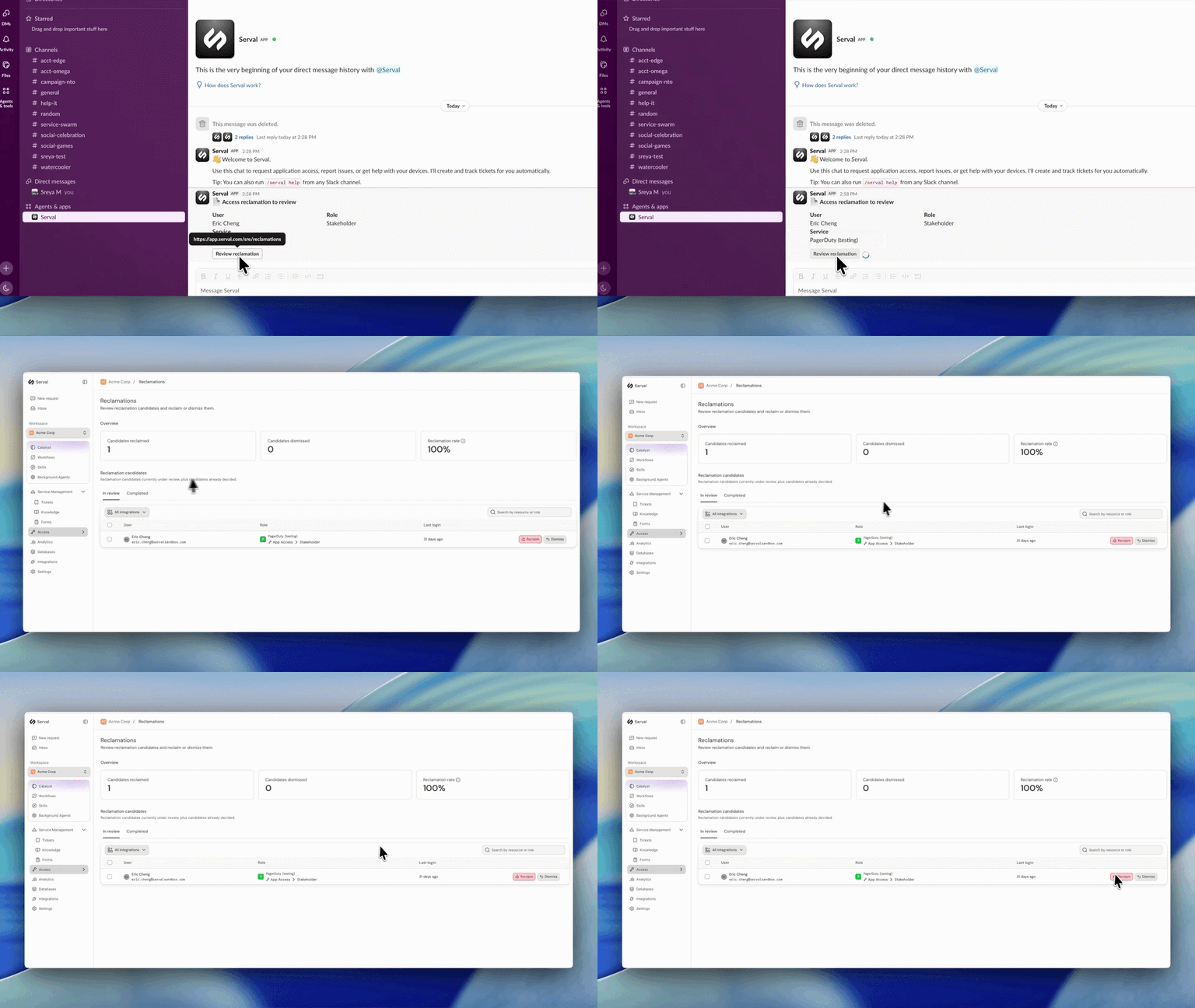
Introducing automated license reclamation
Serval reclaims seats as they go unused, on a policy you set once.
Product
Announcing general availability of Catalyst
Today, we're excited to announce that Catalyst is generally available and will be enabled by default for all organizations.
Product