IT service management (ITSM): A guide for modern businesses
Published
Here’s a common IT scenario: An employee can’t log in to a critical app, so they send a message to an IT team member who’s heads-down on another task. The IT person sees the chat 40 minutes later and manually provisions access without logging a record. When another employee submits the same request next week, the whole process repeats.
In this situation, every step happens outside of a system. There’s no ticket, no routing, and no record of the request. That means there’s no visibility into what’s been provisioned and no way to audit who has access to what.
The problem here isn’t the team’s speed. It’s a lack of infrastructure guiding the work. IT service management (ITSM) governs how IT delivers work across the organization. When it’s implemented well, the access request that took 40 minutes is done in moments with a full audit trail.
This guide explains how modern ITSM works in practice and what AI-native platforms add to the process.
What’s service management in IT?
ITSM is the practice of managing IT services as a business. Leaders establish processes with ITSM, meaning they define how people submit, triage, and fulfill requests. Once they’ve determined the ideal system, they build the infrastructure to run them consistently at scale.
The contrast with ad-hoc IT support is as much financial as operational. Every hour an employee waits on an unresolved issue is an hour of lost productivity. Every ticket that gets lost in a Slack thread adds to a backlog that compounds over time. Well-crafted ITSM reduces time and money spent per request and lets every employee get back to work.
A typical ITSM workflow looks like this:
- An employee submits a service request through a communication channel, like a self-service portal, Slack, or Teams.
- IT software automatically creates a ticket based on request type, urgency, and routing rules.
- The tool routes the request to an automated workflow. Software may also route the issue to a human, depending on preset preferences.
- The issue is resolved. This is where the biggest gap between platforms shows up. In platforms like Serval, service delivery is hands-off: The Help Desk Agent triggers an automation and closes the ticket end to end. In legacy ITSM, human service desk agents tackle a request when they have time.
- IT software logs the issue for a complete audit trail. It may also update the knowledge base with new information. Serval’s Insights Agent learns from resolved tickets and suggests opportunities for new automations and knowledge base improvements. The system gets smarter over time, and IT teams stay in full control of how it evolves.
The value of an IT service management system lies in the consistency across every single step. When requests enter a defined process and resolve in minutes, IT can stop reacting and start delivering.
Key benefits of ITSM for modern IT teams
Structured processes deliver noticeable results across speed, workload, and security. Here’s what to expect.
Faster resolution times
Back-and-forth messaging delays resolution, but defined workflows and automation cut out the manual coordination that slows requests down. Serval’s Help Desk Agent handles issues across Slack, Teams, and email automatically, collapsing the gap between “submitted” and “resolved” from hours to minutes.
Real-world example: Serval helped Perplexity automate more than 60% of IT requests, saving each admin 1–2 hours per day.
Reduced IT workload
AI help desk agents and self-service flows handle routine work like resetting passwords and granting tool access. This lets teams focus on problems that actually need human input. For instance, teammates should solve ransomware threats. These issues are a high-risk security threat, and human attention ensures compliance.
Automatic tools also flag recurring issues. Instead of tackling the same problem repeatedly, employees can target and eliminate them for smooth future workflows.
Real-world example: Mercor used Serval to operate a 24/7 help desk and achieve 50% zero-touch resolution.
Improved security and compliance
Skipping over audit logs and approval are the norm in one-off scripts and workflows outside of a system. Structured processes and automatic platforms ensure security and compliance are never an afterthought. Access controls, approval workflows, and audit trails automatically become part of every request with ITSM.
For example, Serval logs every provisioning and deprovisioning event with full inputs, outputs, and timestamps. And every record is exportable for audit purposes.
Real-world example: Serval helped Together AI automate 95% of just-in-time access requests with complete auditability on every run.
Cross-team scalability
ITSM practices don't have to stop at the IT department boundary. Countless departments benefit from consistent workflows and AI tools. The same fulfillment model applies to processes like HR onboarding, finance approvals, and legal intake, resulting in enterprise-wide service management.
Real-world example: At Mercor, IT deployed Serval first. After seeing the benefits, HR, engineering, and security soon followed.
Core ITSM processes and practices
While ITSM practices are all different, they should be standardized and repeatable enough to run without constant human intervention. Here are some of the common building blocks:
- Request fulfillment: Handling routine service requests through structured, automated workflows
- Incident management: Restoring normal service as quickly as possible after an unplanned disruption
- Problem management: Identifying and eliminating the root cause behind recurring incidents
- Change management: Planning and controlling modifications to IT systems to minimize disruption
- Knowledge management: Capturing, surfacing, and maintaining solutions to streamline future requests
- Access management: Governing who has access to which systems and for how long
Serval also supports asset management as part of its system of record. This tool lets leaders view status, owner, and activity at a glance. New configurations are added, simply by asking the system to ingest data. Changes flow in automatically, keeping the register current without manual updates.
Popular ITSM frameworks
Frameworks are guides and standards for how to implement ITSM. They aren’t mutually exclusive, and many companies use multiple systems together. Here are the most common ones:
- ISO/IEC 20000: This is the international standard for ITSM. It sets formal requirements for audit and organizational certification.
- COBIT: A governance and management framework that aligns IT with business objectives and risk management.
- ITIL 4: A best practice framework that combines Agile, Lean, and DevOps methodologies. It guides teams on providing adaptable service delivery over rigid process checklists.
Keep in mind that ITIL was designed when automating ticket resolution wasn’t feasible and humans handled every step. It supports fast, high-quality co-creation, but modern tools go beyond streamlining manual processes. AI platforms like Serval resolve tickets, not just track them.
How to choose the right IT service management tool
There’s a large service gap between legacy and AI ITSM software. Legacy tools deflect requests to humans who close them manually. AI-native platforms like Serval are built around a different idea: routine tickets shouldn’t need a human at all. This difference impacts speed, auditability, and security.
Here’s how to evaluate ITSM systems for the greatest efficiency and value:
- Automation depth: Ask vendors for AI-Resolved rates, and look for evidence in customer outcomes. For instance, Serval’s Help Desk Agent automates at least 50% of all tickets guaranteed. Routine questions shouldn’t stall requesters and IT team members, and reducing human intervention lets everyone continue work without friction.
- Speed to value: Determine how fast you can build and deploy workflows. Serval’s Workflow Builder generates automations from plain-language descriptions. There’s no need for engineering resources and multi-month implementation.
- Channel flexibility: Confirm the tool lives where your team works and employees submit requests. People avoid tool switching, and poor integration may slow adoption. Serval’s Help Desk Agent connects natively across Slack, Teams, email, and web portals.
- Security and governance: Look for platforms with configurable approval and automatic audit logs. These integrated security features make necessary compliance a convenience, not a bottleneck.
Take the manual labor out of ITSM
ITSM gives teams the structure to deliver consistent, scalable service. Organized processes and frameworks provide a foundation, and the platform underneath propels service forward. Instead of reacting to whatever’s loudest in the queue, people focus on high-priority tasks as AI solves requests. If you’re looking to refine IT delivery, reach out to Serval.
Serval is built for teams ready to put principles into practice without the implementation overhead. AI platforms make ITSM success rapid and measurable. With Serval, you get:
- AI agents that resolve requests end to end
- Workflows built from plain English, delivered in TypeScript
- Unified ticketing, access management, and asset management
Book a demo to see how Serval handles high volumes of requests from day one.
FAQ
What does ITSM stand for?
ITSM stands for IT service management. This refers to the practices, processes, and tools organizations use to plan and provide IT services. The core idea is treating IT as a service with defined workflows and accountability instead of responding to issues ad hoc.
Is ITIL the same as ITSM?
No. ITSM is the practice; ITIL is a framework for implementing it. ITSM describes the discipline of structured service delivery, while ITIL 4 is a widely used guide for putting that process into action.
What are the best ITSM tools focused on resolving requests quickly?
The ITSM tools that resolve requests quickly automate tickets with AI. This means software receives, processes, and closes requests without human involvement. Serval is a great example. Our Help Desk Agent works across communication channels to resolve issues using pre-built, auditable workflows.
You may also be interested in
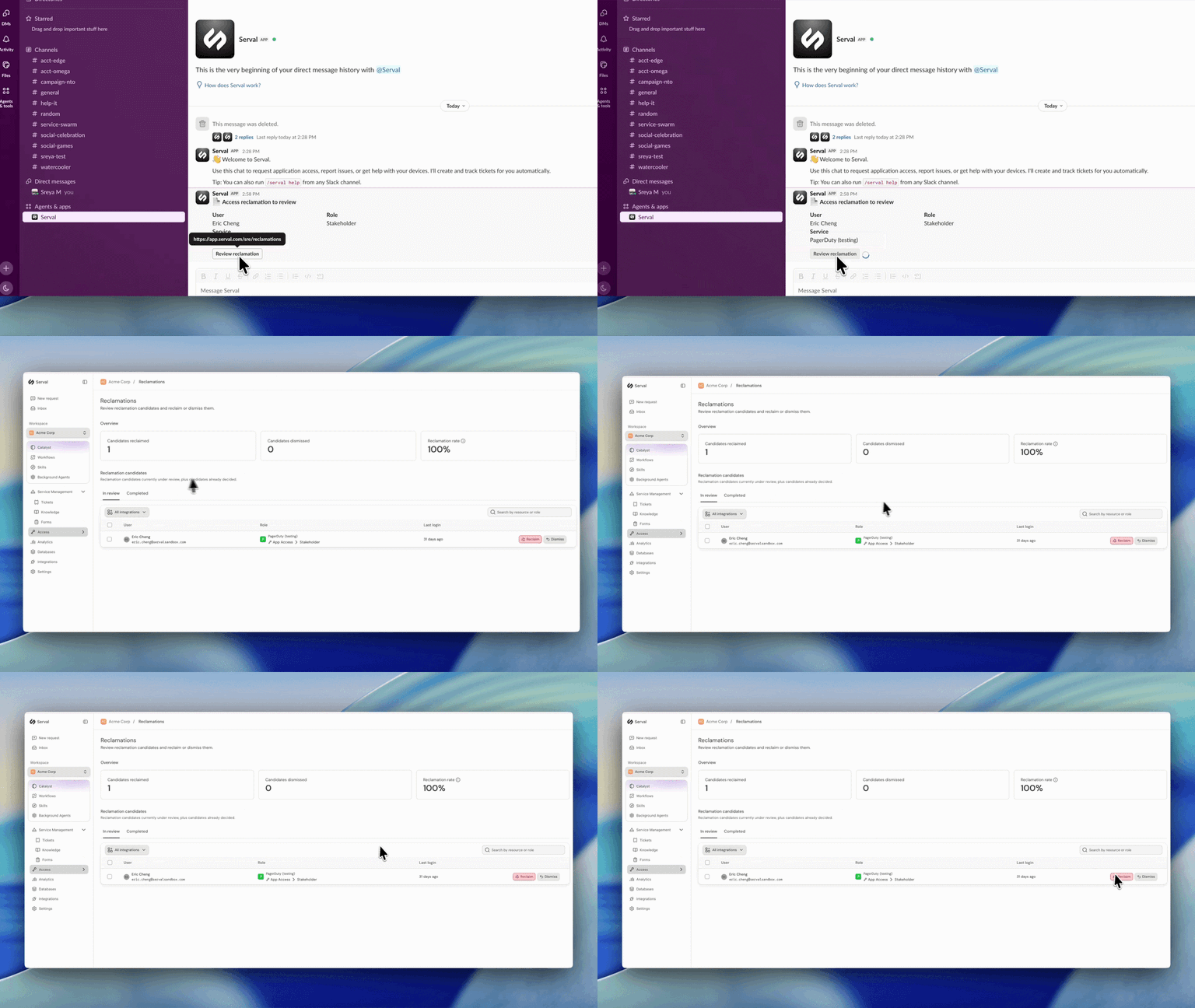
Introducing automated license reclamation
Serval reclaims seats as they go unused, on a policy you set once.
Product
Our approach to hiring: fewer, better, every time
Hiring is the single highest-leverage thing we do at Serval. Every person we bring on either raises the bar or lowers it, so we treat hiring the way we treat…
Company
Serval Launches Program to Transform Employees Into Future Founders
Serval start challenges traditional career paths and retention strategies for startups.
Company